
At some point in almost every successful career, something changes.
The same person who had been trusted, praised, and consistently given more responsibility starts feeling a different kind of friction. The results are still there. The work ethic has not disappeared. The ambition is still intact. But the forward motion slows down. Promotions do not come as expected. Visibility becomes less consistent. Conversations about the future start sounding vague.
For many high performers, this moment feels confusing because it does not match the story they had been told. If you work hard, deliver strong results, stay committed, and keep growing, the next opportunity should follow.
In practice, that is not always how leadership progression works.
What looks like a sudden ceiling is often the point where performance alone stops being enough. Not because performance no longer matters, but because the criteria for advancement have changed. At higher levels, organizations start evaluating people through a wider lens that includes judgment, influence, trust, communication, operating maturity, and the ability to perform through others, not just as an individual contributor. Research and executive guidance from Harvard Business Review continues to reinforce that leadership advancement is tied not only to output, but to broader signals of readiness and influence.
The ceiling is often not about effort
One of the biggest misconceptions high performers carry is the belief that if progress slows, the answer must be to work even harder.
Sometimes that instinct helps in the short term. More often, it creates a blind spot.
The issue is usually not effort. It is a misalignment between what made someone successful in one stage of their career and what will make them credible at the next one.
A leader can be excellent at execution and still struggle to earn confidence as a broader business operator. Someone can be highly respected for technical depth and still not be seen as ready to lead at enterprise level. A manager can deliver strong results inside their own function, yet still fall short when the role begins to demand cross-functional influence, strategic communication, or the ability to align senior stakeholders.
This is where many careers stall quietly. The individual keeps performing, but the organization starts looking for a different kind of signal.
High performance can sometimes hide the real problem
In some cases, the person is so strong in their current role that the company becomes dependent on them there.
That can sound flattering, but it creates risk. A leader who is indispensable in execution is not always given the room to prove they can operate above it. Instead of being stretched into broader responsibility, they become the safe pair of hands the business does not want to move.
This happens more often than companies admit.
McKinsey’s work on the talent moves and metrics that matter and on linking talent to value points to the importance of evaluating people not only by immediate output, but by where they can create the most strategic value for the organization. When businesses fail to do that, they often keep their strongest people locked in the very roles they have already outgrown.
From the individual’s perspective, this ceiling feels personal. From the company’s side, it often reflects a weak leadership development system.
Sometimes the problem is not capability, but visibility
There is another reason strong performers hit a ceiling that deserves more attention.
In many organizations, senior advancement depends on more than competence. It depends on how clearly others can see your judgment in moments that matter.
That includes how you handle ambiguity, how you communicate under pressure, how you influence peers, how you represent the business in front of senior leadership, and whether people trust you with problems that do not come with clean boundaries.
This is where many highly capable professionals get underestimated. They are known for reliability, but not yet for enterprise perspective. They are seen as strong contributors, but not yet as people who can carry broader leadership weight.
That gap is not always fair, but it is real.
What companies often miss
Organizations are quick to say they want to retain high performers, but many are less disciplined about creating real pathways for them.
A high performer does not only need recognition. They need an honest signal. They need to know what the next level actually requires, what is missing today, and whether the business is prepared to create room for that growth.
Deloitte’s recent Global Human Capital Trends research emphasizes how much pressure organizations are under to move with speed, adaptability, and stronger coordination across people and resources. In that environment, unclear advancement standards become more costly, not less.
When companies avoid direct conversations, they create frustration on both sides. The individual feels overlooked. The business assumes the person is not ready. Neither side deals with the real issue.
What high performers should do about it
The answer is not to become louder, more political, or endlessly patient.
The better move is to become more precise.
Start by asking a harder question: is this ceiling telling you that you need new capabilities, more visible opportunities, or a different environment altogether?
Those are not the same problem, and they do not lead to the same decision.
If the gap is capability, the work may involve strengthening executive presence, broadening business exposure, improving stakeholder management, or showing that you can lead beyond your own function.
If the gap is visibility, you may need more deliberate opportunities to participate in strategic discussions, own cross-functional initiatives, or represent the business in higher-stakes settings.
If the gap is structural, meaning the company has no real room or willingness to rethink your role, then the ceiling may not be about your limits at all. It may simply be the edge of what that environment can offer.
That distinction matters because many talented people spend too long trying to solve the wrong problem.
The more useful way to read the moment
Hitting a ceiling can feel discouraging, especially for people who are used to momentum.
But in many cases, it is also clarifying.
It forces a shift from performance as proof to readiness as a broader question. It reveals whether the company truly knows how to develop talent, whether leadership criteria are being applied clearly, and whether the next move should be built internally or pursued somewhere else.
For companies, these moments are equally revealing. If strong performers keep stalling, the issue may not be individual ambition. It may be a leadership system that is too vague, too narrow, or too dependent on people staying exactly where they are most useful.
For the individual, the ceiling is not always a stop sign.
Sometimes it is the first honest signal that the next phase of growth will require a different kind of move.
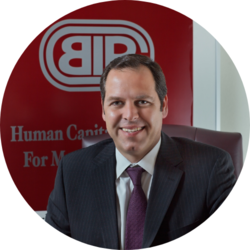
By Fernando Ortiz-Barbachano
President & CEO of Barbachano International
Barbachano International (BIP) is the premier executive search and leadership advisory firm in the Americas with a focus on diversity & multicultural target markets. Since 1992, BIP and its affiliates have impacted the profitability of over 50% of Fortune 500 Companies. BIP has been recognized by Forbes as Americas’ Best Executive Search Firms and currently ranks #8 and #3 on the West Coast.